
Introduction to Time and Motion Studies
In today’s competitive business environment, companies must continuously seek ways to improve their productivity and efficiency. One of the most effective methodologies used by industrial engineers is Time and Motion study, and its goal is to optimise business operations. Henry Ford said, “Time waste differs from material waste in that there can be no salvage”, and it is with this perspective in mind that Time and Motion studies can add immense value. Time and Motion studies are widely used in many industries, including manufacturing, mining, healthcare and logistics.
The steps involved in doing a Time and Motion study are to design, define and redefine job assignments to eliminate waste and enhance efficiency. According to Professor Paul Adler from the University of California, by doing a Time and Motion study, motivation and satisfaction are also increased due to positive changes in the workplace.
A Time and Motion study consists of two key components:
- Time study: Measuring the time to complete a task to improve efficiency
- Motion study: Evaluating the movements in the process to improve the way they are performed
Both elements work together to improve the way of executing work and the time spent. By looking at a combination of both it ensures that non-value-added activities are eliminated and that the processes within the business are streamlined. For example, in manufacturing, time studies may reveal that an operator takes 12 seconds to complete a task, but motion studies might show that 4 of those seconds are due to unnecessary movements, such as reaching too far for the tools necessary to do a task. By optimising both the time and the motion of the employee, the process can be made more efficient.

Time and Motion studies are derived from the concept of “task standardisation” and the focus is to reduce unnecessary motions which is also the foundation of lean principles.
Historical Context and Key Figures
The origins of Time and Motion studies trace back to the late 19th and early 20th centuries, pioneered by Frederick W. Taylor and Frank and Lillian Gilbreth. Taylor, often called the father of scientific management, conducted experiments at the Midvale Steel Company in the 1880s, focusing on time studies to measure task durations and establish standard times. His work, detailed in “The Principles of Scientific Management“, emphasised reducing time wastage for maximum efficiency, laying the groundwork for modern industrial engineering.
Frank and Lillian Gilbreth expanded on Taylor’s ideas by introducing motion studies, analysing worker movements to eliminate inefficiencies. They developed the concept of “therbligs,” 18 fundamental motions used to break down tasks into their smallest components, such as “grasp” or “transport loaded.” Their work, including “Motion Study for the Handicapped”, highlighted the importance of ergonomic design and worker well-being, integrating psychological insights into industrial processes.
Steps for conducting a time and motion study
The stepwise approach we use for conducting time and motion studies at Ivoda can differ, depending on the client’s needs as well as the process involved. Analysing drill rig operators in a mine busy drilling holes in a mining face has more visual process ques than observing reception staff handling queries at a hospital. For the drill rig operations, the ‘start’ and ‘stop’ of the drilling operation are easily recognisable, however with a receptionist working on a computer the observation process requires more intuitive observations and interaction with the receptionists.
We ensure that all relevant data is accurately gathered, analysed, and applied to improve productivity.
The following cycle outlines our considerations when performing a time and motion study:
- Select a task that is repetitive and has improvement potential
- Breaking tasks into specific process steps
- Observe and time each of the process steps, utilising technology to ensure high accuracy
- Analysing motion of process steps by possibly using therbligs (if applicable)
- Evaluate process standard times and motion
- Propose processes to improve using actual measured performance metrics
- Implement process improvements and monitor results to ensure effectiveness

The key steps in our time and motion study process are illustrated below.
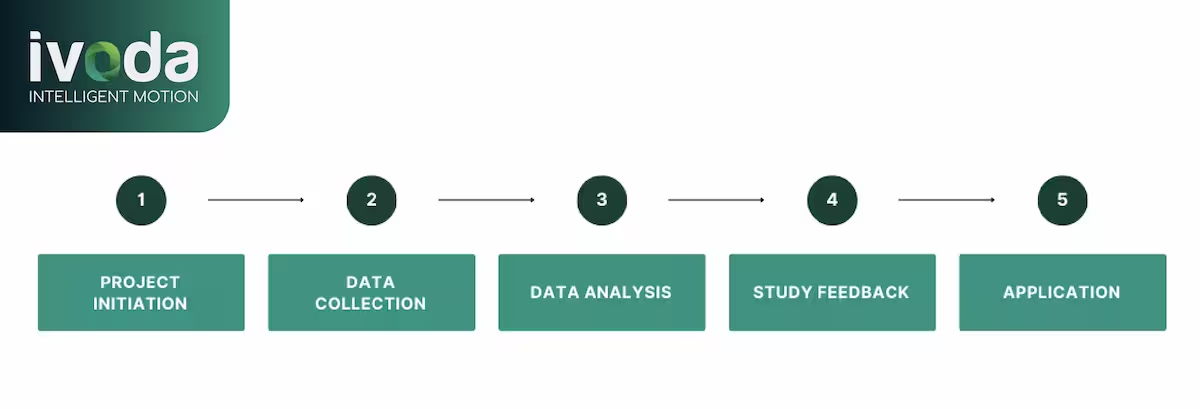
Below are the detailed steps in a time and motion study conducted by Ivoda:
- Project initiation:
- Define the aim of the study.
- Identify the tasks and subsequent processes to analyse.
- Understand the scope and set the objectives.
- Identify the key tasks to be measured and relevant variables.
- Get any SOPs or documentation on how the tasks should be performed.
- Data collection:
- Gather existing documentation and operational data.
- Obtaining information via on-site observations and measurement (using stopwatches, video recordings and software tools to ensure data collection accuracy). The table below shows a simple example of a time and motion study that can be recorded manually on paper:
| Date | Operator | Task | Start Time (hh:mm:ss) | End Time (hh:mm:ss) | Duration (hh:mm:ss) |
|---|---|---|---|---|---|
|
12/02/2025 |
Operator 1 |
Lifting box |
16:02:54 |
16:02:56 |
00:00:02 |
|
12/02/2025 |
Operator 1 |
Walking |
16:02:57 |
16:03:10 |
00:00:13 |
- Data collection (continued):
- Break down tasks into elements, and observe and measure each step in the workflow.
- Conduct interviews with operators.
- Data analysis:
- Process mapping and workflow analysis.
- Remove the redundant steps.
- Quantitative data analysis (e.g., statistical analysis, work sampling).
- Identify inefficiencies via data analysis and on-site information that is gathered.
- Study feedback:
- Feedback presentation and workshop with management to discuss findings and action plans.
- Detailed discussion of study results.
- Discussion of bottlenecks and process constraints.
- Highlight and quantify potential improvements to streamline workflow.
- Application:
- Apply refined processes.
- Train the employees on the optimised workflows.
- Tracking the performance (e.g., key performance indicators, dashboards).
As an example: in a manufacturing line, inefficiencies arise when workers walk long distances to retrieve tools. Suppose an employee walks 20 meters every hour to fetch a tool. If they work an 8-hour shift, that amounts to 160 meters per day or over 3 kilometres per month – a wasted movement that adds up over time. A simple solution, such as placing a tool trolley next to the workstation, can reduce wasted motion, save hours of labour, and improve workflow efficiency. While purchasing extra tool trolleys may have an upfront cost, the long-term savings in labour time and productivity gains far outweigh the expense.
Why a Time and Motion study is important
In the book The Toyota Way, eight types of non-value-added activities are identified in a business or manufacturing facility and every process contains waste that should be reduced to achieve lean efficiency. Our focus during the time we spend on site is to not only observe and record time and motion but to identify these wastes, and develop strategies to eliminate them. The data that is available after a Time and Motion study was conducted also provides a perfect platform for developing KPI’s (Key Performance Indicators) for employees that is attainable and backed by measured data. Too often KPI’s are developed based on theoretical performance and therefore employees struggle to meet targets, however, with actual performance data, KPI’s are not only attainable, but the results of achieving the KPI are quantifiable.
Time and Motion studies should form part of an organisation’s continuous improvement strategy and will drive not only process efficacy but also employee workplace satisfaction.
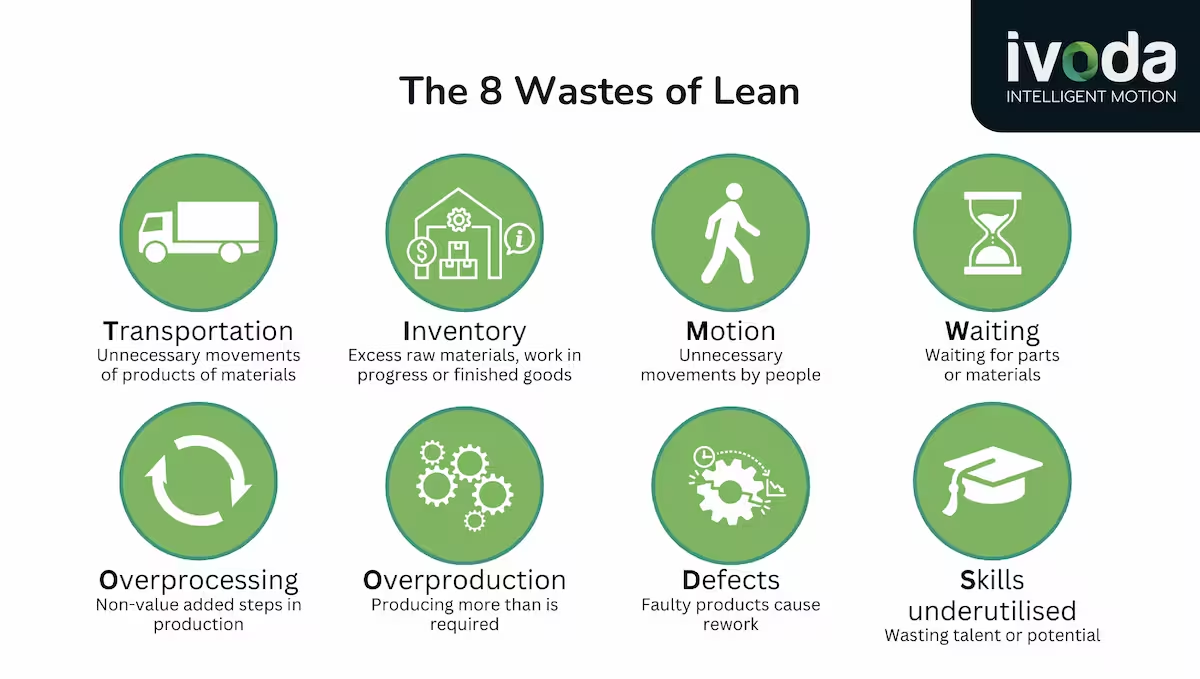
Time and motion studies offer several benefits for business optimisation. According to Professor Paul Adler from the University of California, these advantages include:
- Increased Efficiency: Eliminating unnecessary steps leads to faster and more effective work processes. For example, Toyota’s Lean Manufacturing System integrates motion studies to remove inefficiencies in assembly lines, reducing production time and costs.
- Reduced Operational Costs: Streamlined workflows minimise resource wastage and help cut unnecessary labour and material expenses, with examples like Toyota achieving lower production costs through lean methods.
- Standardised Work Procedures: Establishing consistent processes enhances quality control and operational stability. This ensures that there is consistency in task execution. With Time and Motion studies, processes and work methods are standardised and as per the ISSSP (International Society of Six Sigma Professionals) for Lean Six Sigma, standardising methods enhances output quality.
- Better Workforce Planning: Data-driven labour allocation ensures optimal staff utilisation and improved productivity. In the agricultural industry, companies use motion studies to adjust staffing levels based on peak seasons, improving harvest and packing operations while reducing unnecessary labour costs.
- Informed Decision-Making: Provides quantitative data for performance improvements
- Better Worker Health and Safety: Ergonomic improvements reduce injury risks, aligning with Gilbreth’s focus on worker well-being.
- Enhanced Employee Morale: Workers in efficient systems report higher satisfaction, as noted in the Project Review Insights blog posted on November 30, 2023.
Industry examples
In the mining industry, time and motion studies are crucial for optimising equipment utilisation, shift efficiency, and haulage cycle times. The examples below show the potential impact of Time and Motion studies.
- Mining – Haul Truck Cycle Optimisation: A study might reveal that trucks spend excessive time waiting at loading points. By adjusting dispatch schedules or using real-time tracking, truck idle time can be reduced, improving overall production rates.
- Mining – Drilling and Blasting Operations: Time studies can help analyse the work performed, including travel time and pre-shift meetings, to identify inefficiencies that cause delays in drilling the first hole.
- Logistics – Maintenance Scheduling: Motion studies can track the time required for equipment inspections and repairs, leading to better preventive maintenance planning, reducing downtime, and avoiding costly days lost.
- Health Care – Equipment placement and distances: Time and Motion studies for nurses fetching and searching for equipment in the emergency department can reduce the time walking between supply rooms and patient beds by relocating supplies closer to the treatment areas.

Time and Motion study is a powerful tool for businesses looking to enhance efficiency, reduce costs, and improve productivity. By adopting this methodology, companies can refine their operational workflows and gain a competitive advantage in their respective industries.
Challenges and mitigation Strategies with Time and Motion studies
Typical challenges with conducting Time and Motion studies include the following:
- Resistance to Change: Employees fear scrutiny, downsizing, pay-cuts etc. Mitigation includes involving employees in the studies, explaining benefits, and providing adequate training.
- Complexity: More often, especially in the services industries (Healthcare, agriculture, hospitality) the task sets are complex and require the study team to break tasks into smaller parts, using advanced analytical tools.
- Time-Consuming: Studies usually need significant resources, but technology, like video analysis, can streamline the study process.
- Technology Updates: As technology increases, tasks and processes can become outdated and therefore continuous learning is needed, with tools like machine learning for data analysis, as per the ScienceDirect article Time motion studies in healthcare: What are we talking about?
What to Do Next
Time and Motion studies remain vital for operational excellence, offering a structured approach to efficiency improvements. At Ivoda Consultancy, we don’t just analyse processes – we deliver measurable results. Whether you’re in mining logistics, healthcare, agriculture, or manufacturing, our expertise in time and motion studies can help you unlock cost savings, efficiency gains, and operational improvements.
Curious about how time and motion studies can transform your business?
Visit our services page to learn more about how we can help your business achieve operational efficiency through time and motion studies. Contact us today for a free consultation or request a case study to see real-world examples of our impact!
References
- Adler, P. S. (1993, January). Time-and-Motion Regained. Harvard Business Review, 97-108. Retrieved from Harvard Business Review.
- Maynard, H. B., & Zandin, K. B. (2001). Maynard’s industrial engineering handbook. McGraw-Hill.
- Starting the Journey of Waste Reduction. (2006). In J. K. Liker, & D. Meier, The Toyota Way Fieldbook (pp. 33-36). United States of America: McGraw-Hill.
- Stibbe, M. (2023, November 7). How to Do a Time and Motion Study to Make Real Change. Retrieved from IDoneThis: https://blog.idonethis.com/how-to-do-a-time-and-motion-study-to-make-real-change/
- Toussaint, J. S., & Berry, L. L. (74-84). The Promise of Lean in Health Care. Mayo Clinic Proceedings, 2013.
- Lopetegui, M. et al. (2014) Time Motion Studies in Healthcare: What are we talking about?, Journal of Biomedical Informatics. Available at: https://www.sciencedirect.com/science/article/pii/S1532046414000562 (Accessed: 24 February 2025).