
Introduction to Simulation Modelling
Simulation modelling is a powerful computer-based method that builds digital replicas of real-world systems, enabling businesses to explore different scenarios and test ideas before committing significant resources. By creating a virtual environment, companies can experiment with changes, spot potential problems, and improve processes without the high costs or risks of real-world trial and error. This technique is used across many industries – from optimising supply chains and streamlining manufacturing to enhancing healthcare systems and managing complex logistics networks. As McKinsey & Company once noted, “Simulation modelling is transforming the way organisations operate by providing insights that are otherwise hard to capture in the real world.”
Reflecting on the forward-thinking nature of this tool, management guru Peter Drucker famously said, “The best way to predict the future is to create it,” a sentiment that perfectly captures the essence of simulation modelling. Additionally, in his influential work on discrete-event simulation, industrial engineering author David Banks highlights how these models not only help businesses foresee challenges but also pave the way for smarter, data-driven decisions.
Together, these insights underscore simulation modelling as an essential tool in unlocking efficiency and driving business optimisation in an ever-changing marketplace.
Why Is Simulation Modelling Important?
Discrete event simulation is a key part of simulation modelling because it breaks down complex business processes into individual events that can be closely examined and improved. Instead of guessing how changes might affect the system, companies use this method to simulate each step of a process, providing a detailed, step-by-step view of operations. This is especially valuable in fast-paced industries where even small delays can lead to significant losses. By testing different scenarios in a virtual setting, businesses can identify bottlenecks, optimise
resource allocation, and predict future challenges – all without risking disruptions to actual operations.
As Accenture once noted, “By simulating real-world events, businesses can forecast potential issues and strategise effectively before committing resources.” This insight underlines the practical value of simulation modelling: it offers a risk-free environment to experiment and refine strategies. In his influential research, industrial engineering expert David Banks demonstrated how discrete event simulation transforms raw data into actionable insights, enabling managers to make informed, data-driven decisions.
Some of the most common reasons why companies use simulation modelling include:
- Identifying Bottlenecks: Recognising and addressing delays or inefficiencies within a process.
- Resource Optimisation: Efficiently allocating manpower, machinery, and materials to maximise productivity.
- Cost Reduction: Experimenting with process improvements virtually to avoid costly mistakes in the real world.
- Risk Management: Predicting potential issues and formulating contingency plans before problems arise.
- Strategic Planning: Testing various scenarios to determine the most effective strategies for future growth.
- Process Improvement: Continuously refining business processes based on simulated outcomes to enhance overall efficiency.
Through these benefits, simulation modelling has proven to be an indispensable tool in unlocking operational efficiency and driving smarter business decisions.

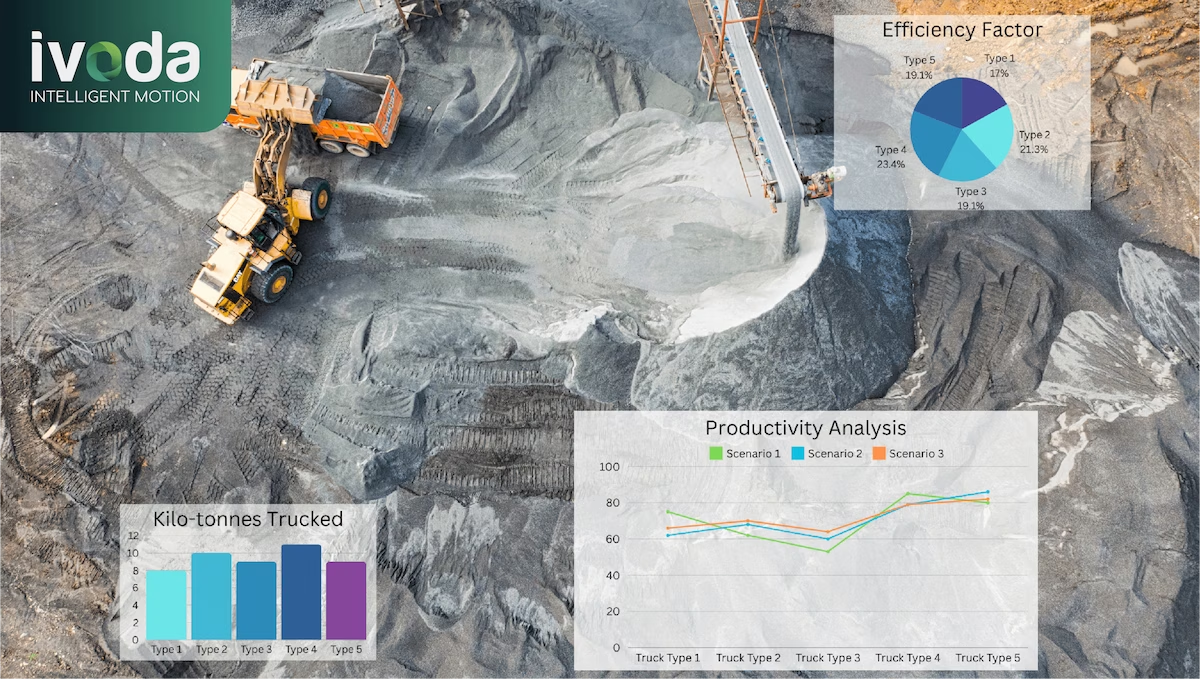
Consider a mining logistics operation. The intricate coordination of equipment, personnel, and schedules can result in costly delays if mismanaged. A simulation model can help visualise the entire process, test alternative strategies, and implement the most efficient solutions. Similarly, healthcare facilities can use simulation to improve patient flow, reduce wait times, and allocate resources effectively.
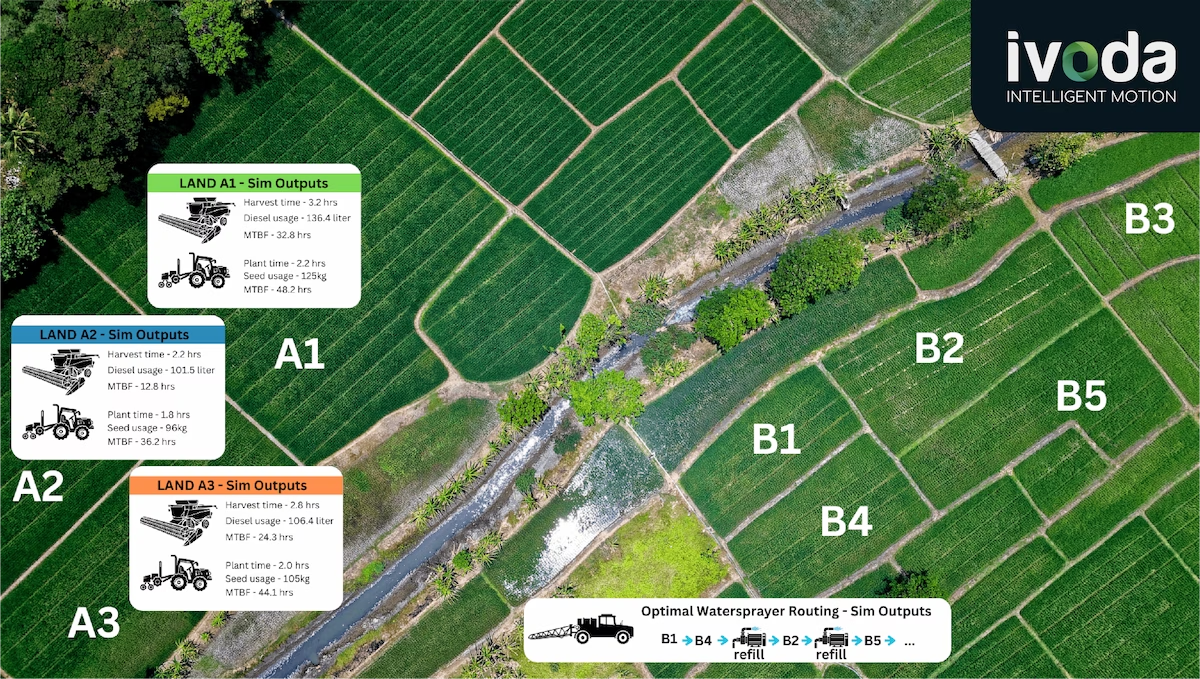
In agriculture, simulation models enable farmers to optimise irrigation, plan harvests, and manage labour more effectively. For the hospitality industry, these models help streamline operational processes, with optimised staff allocation, layout planning and facility design.
Benefits of Simulation Modelling for Business Optimisation
Simulation modelling offers a range of tangible benefits that help businesses save money and reduce risk while testing new ideas. By creating a virtual version of a process, companies can experiment with different scenarios before spending resources on physical implementations. As McKinsey & Company puts it, “Simulation modelling provides a safe and cost-effective way to evaluate even the most complex systems before making any major changes.” This method enables businesses to use 3D visual tools for training purposes, allowing employees to interact with realistic simulations and understand operations more deeply. It also lets companies visualise the impact of process variability and test systems under various conditions – even simulating rare disaster events, such as scenarios that might occur only once every 50 years..
Industries such as manufacturing, logistics, and healthcare, which are among the sectors Ivoda services, can especially benefit from this innovative approach by reducing costs, improving efficiency, and preparing for unexpected challenges.
Below is a table outlining some of the tangible benefits of simulation modelling for business optimisation:
| Benefit | Description | Industry Application |
| Cost Efficiency | Test scenarios virtually to reduce expenses before building or implementing in real life. As McKinsey & Company puts it, “Simulation modelling provides a safe and cost-effective way to evaluate even the most complex systems.” | Manufacturing, Logistics, Healthcare |
| 3D Visual Training Tools | Use realistic 3D models to train employees, making it easier for them to understand and practice processes in a simulated environment. | Manufacturing, Healthcare, Education |
| Visualisation of Process Variability | See how changes in processes affect outcomes. This helps managers spot issues early and plan for adjustments before problems occur. | All industries |
| Testing Extreme Scenarios | Simulate rare, high-impact events – like disasters that might occur once every 50 years – to prepare effective contingency plans. | Risk Management, Utilities, Emergency Services |
| Comprehensive Variable Testing | Experiment with different input variables to see how they change the process outcomes, ensuring the system is ready for various conditions and unforeseen challenges. | Finance, Supply Chain, Logistics |
Industrial engineering expert David Banks has shown through his work that these benefits not only lead to smarter decisions but also help create more robust and efficient operations across various industries.
Real-World Applications of Simulation Modelling
- Mining Logistics Optimisation: Reducing equipment downtime, optimising fleet schedules, and streamlining supply chains to enhance profitability.
- Healthcare Process Simulation: Optimising patient care pathways, reducing emergency room congestion, and improving staff scheduling.
- Agricultural Process Optimisation: Enhancing crop yields through precise irrigation planning, efficient harvesting schedules, and optimised resource allocation.
- Hospitality Industry Efficiency: Streamlining housekeeping operations, reducing food waste, and improving guest satisfaction by optimising service workflows.
- Manufacturing Operations: Increasing production line efficiency, minimising waste, and improving overall throughput.
Key Features of Simulation Software
Modern simulation software offers advanced capabilities that make it indispensable for business optimisation:
- 3D Visualisation: The user interface allows users to visualise processes in a three-dimensional environment, making it easier to identify bottlenecks and inefficiencies.
- Customisable Models: The software supports the creation of tailored models that reflect the unique needs of different industries.
- Data Integration: Modern simulation software integrates seamlessly with external data sources, ensuring that models are built on accurate and up-to-date information.
- Scalability: From small-scale operations to enterprise-level processes, simulation software can be used to build small independent systems and then compile together into a complex system.
By leveraging these features, businesses can gain a comprehensive understanding of their operations and implement strategies to improve performance.
The image below is an example of the 3D Model environment of Simio Simulation Software.
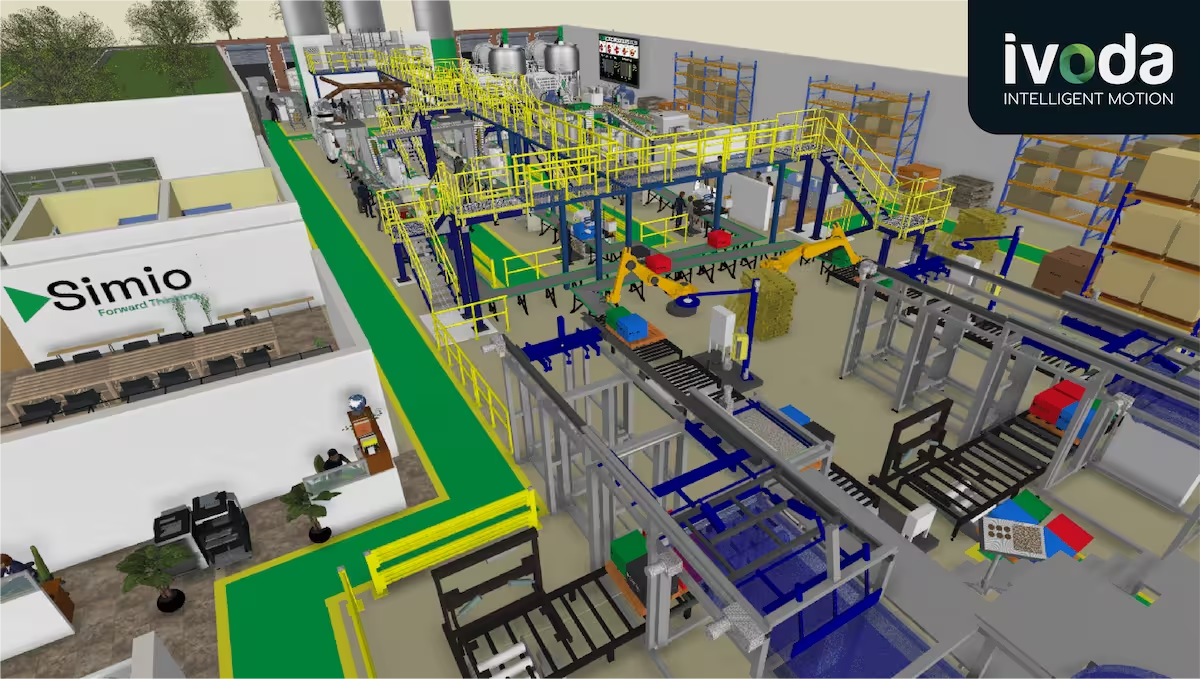
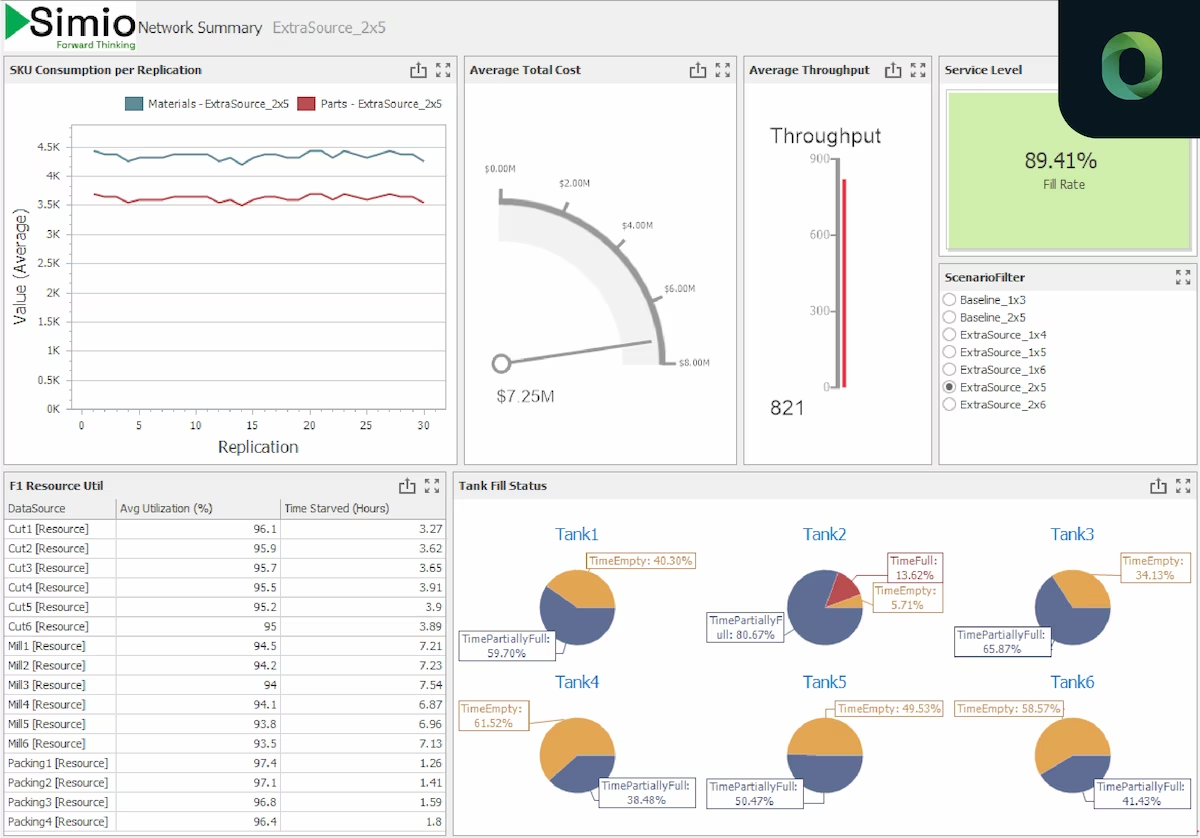
As an example, Simio can provide real-time feedback on each element within the 3D simulated environment. The illustration below is an example of a results dashboard linked to the image above.
Dangers in Simulation Modelling
While simulation modelling is a powerful tool for business optimisation, it is not without its dangers. One key risk is that these models are only as reliable as the assumptions and data that go into them. If the input data is outdated or the assumptions are off, the simulation may lead to misleading conclusions that can affect critical business decisions.
Deloitte once warned, “Simulation models require careful calibration and constant updating; otherwise, they risk becoming outdated and unreliable.” This is particularly true for discrete event simulation, where even minor errors in tracking individual events can add up to significant inaccuracies over time. David Banks has demonstrated that small mistakes in a model can lead to large discrepancies in understanding a system’s true performance. Over-reliance on a simulation – without regular checks and updates – can give companies a false sense of security and potentially steer them in the wrong direction. Therefore, while simulation modelling offers many benefits, businesses must use it cautiously and continuously validate their models to ensure that they truly reflect real-world conditions.
Some of the more common pitfalls that businesses must avoid with simulation modelling:
- Garbage In, Garbage Out: If input data is inaccurate or incomplete, the simulation’s output will be unreliable. Quality data is the cornerstone of effective simulation.
- Models Without Systems Knowledge: A simulation model is only as good as the expertise behind its design. Without a deep understanding of the system being modelled, results may lack relevance or accuracy.
- No Actual Data Used: Using assumptions instead of real-world data undermines the credibility and applicability of the model’s findings.
- Overcomplication: Adding unnecessary complexity to a model can make it difficult to interpret results and implement solutions.
- Neglecting Validation: Failing to validate the model against real-world outcomes can lead to misguided decisions.
Timeframe of Simulation Models
Developing a simulation model can take anywhere from a few days to several months, depending on the complexity of the system and data availability. A typical timeline involves:
- Initial Scoping: Understanding the problem and defining objectives.
- Data Collection: Gathering relevant and accurate information from various sources.
- Model Development: Building the simulation using software like SIMIO.
- Testing and Validation: Ensuring the model reflects real-world behaviours through iterative testing.
- Analysis and Reporting: Presenting actionable insights and recommendations to stakeholders.
How Simulation Modelling Drives Long-Term Value
Simulation modelling is not just a one-time exercise; it is a continuous process that supports long-term business growth. By regularly updating models with new data, businesses can:
- Adapt to changing market conditions.
- Stay ahead of competitors by identifying emerging trends.
- Continuously improve operational efficiency.
What to Do Next
Ready to unlock your business’s full potential? Ivoda Consultancy specialises in creating tailored simulation models for a wide range of industries, including mining logistics, healthcare, agriculture, and hospitality. Our hands-on approach and commitment to excellence ensure solutions that deliver real-world results.
Visit our services page to learn more about how we can help your business achieve operational efficiency through simulation modelling. Contact us today for an obligation-free quote and take the first step toward transforming your business processes.
References
- Banks, J., Carson, J. S., Nelson, B. L., & Nicol, D. M. (2010). Discrete-Event System Simulation. Pearson Education.
- Law, A. M. (2015). Simulation Modeling and Analysis. McGraw-Hill Education.
- Robinson, S. (2014). Simulation: The Practice of Model Development and Use. Palgrave Macmillan.
- Kelton, W. D., Sadowski, R. P., & Zupick, N. B. (2014). Simulation with Arena. McGraw-Hill.
- Pidd, M. (2004). Computer Simulation in Management Science. Wiley.
- Banks, D., Carson, J.S., Nelson, B.L. and Nicol, D.M. (2005) Discrete-Event System Simulation, 4th edn. Pearson Education, Upper Saddle River, NJ.
- Drucker, P.F. (2007) The Essential Drucker: The Best Sixty Years of Peter Drucker’s Essential Writings on Management. HarperBusiness, New York.
- McKinsey & Company (2017) How simulation modelling is transforming business decision making, McKinsey Insights, available at: https://www.mckinsey.com/business-functions/operations/our-insights (Accessed: 7 February 2025).
- Accenture (2020) The Simulation Revolution: How Digital Twins and Modelling are Transforming Business. Accenture Insights, available at: https://www.accenture.com/us-en/insights (Accessed: 7 February 2025).